Review of Gregory Halili, Recollections, Silverlens, New York (through February 28, 2026)
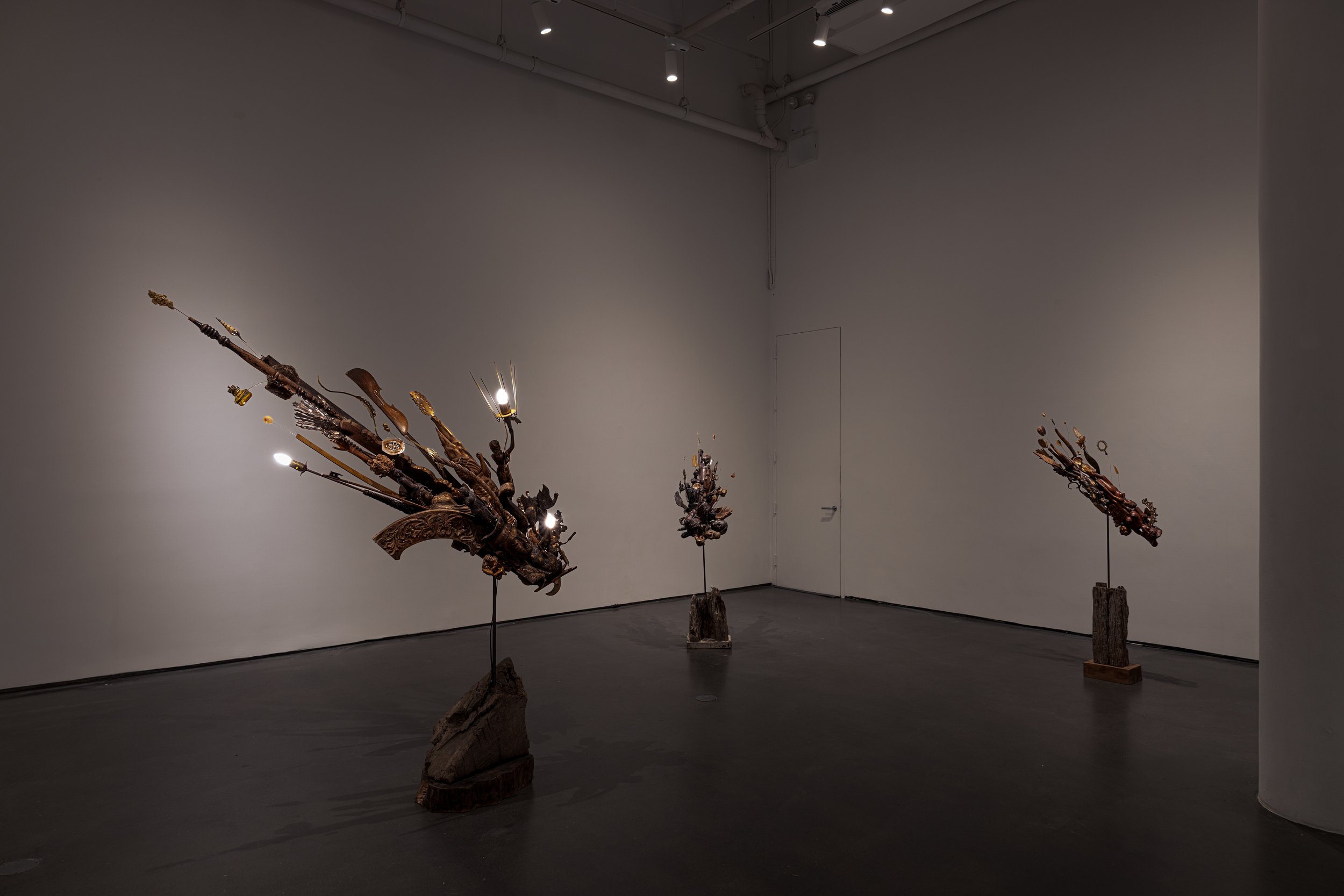
Installation of Gregory Halili, Recollections, Silverlens New York. Image courtesy of Silverlens.
What we now know as Halley’s comet, a frozen ball of gas and dust roughly the size of San Francisco, was once read as a harbinger of catastrophe and ruin. By the time the British astronomer Edmond Halley hypothesized in 1705 that the comet’s return was an explainable phenomenon, not a divine omen, the celestial snowball was already scattered throughout art history, from the Bayeux Tapestry to Giotto’s frescos in Padua.
Comets freighted with a different type of meaning are lighting up Chelsea this winter at Silverlens, New York. Gregory Halili—whose name is evocative of Halley’s—is showing comets he has assembled using items sourced from secondhand shops in the Philippines: lamps, musical instruments, garden ornaments, porcelain fragments along with molten metal, crystals, and shells. Some are rigged as functioning lamps; others feature Halili’s miniature paintings, meticulously rendered on glass and mother-of-pearl. All comets are perfectly balanced on wooden bases (and yes, they spin).
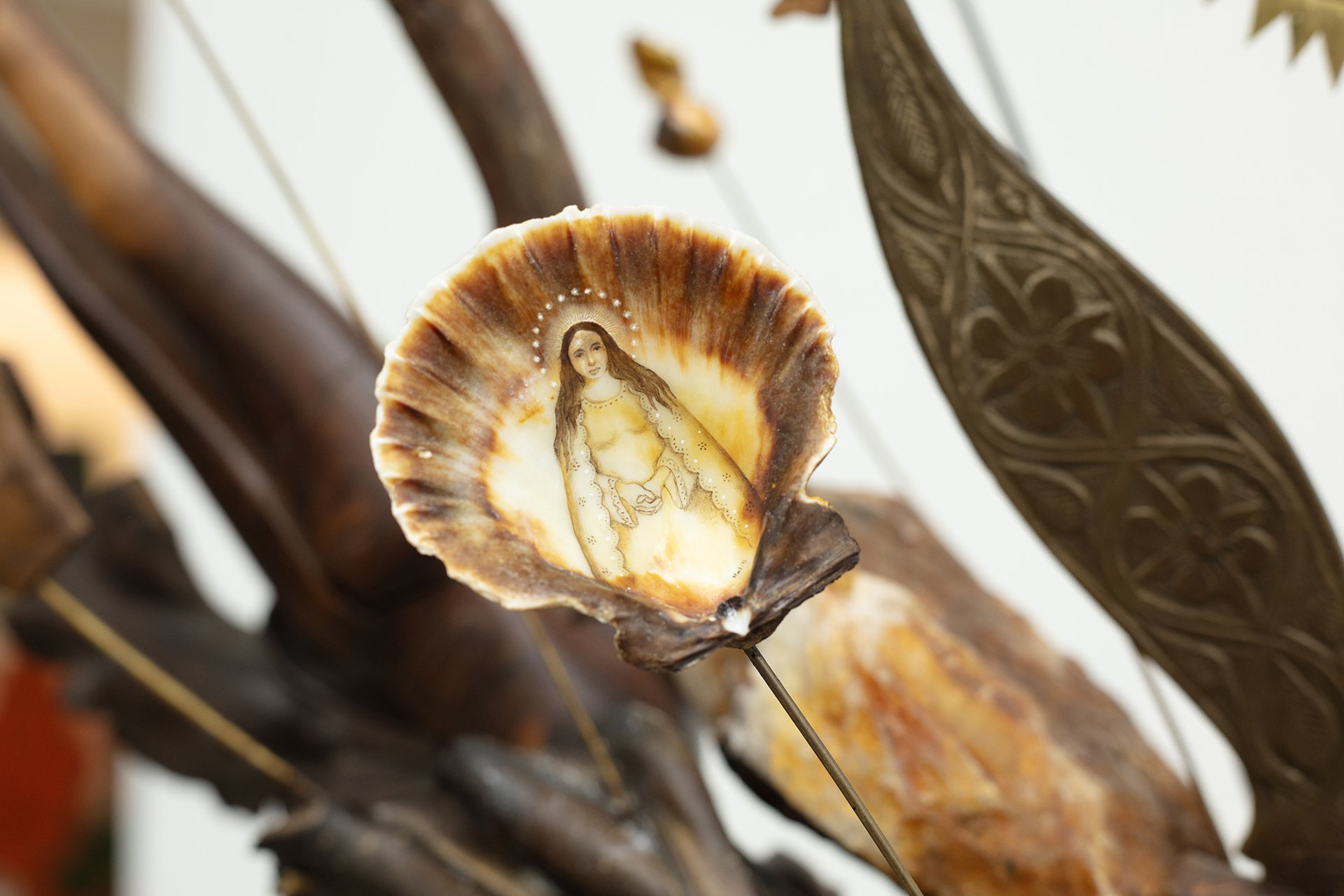
Detail of Crescent (comet XIV), 2024. Image courtesy of Silverlens.
Aristotle described comets as an earthly exhalation (anathumiasis), and Halili’s comets are exhalations in their own way: plumes of overconsumption condensed into form. At first glance, these imploded Wunderkammers can seem almost placeless. One can imagine a similar result if the materials were sourced from thrift stores in Bushwick or Eagle Rock. That the wooden bases are the only “true” Filipino objects seems like a metaphor: an archipelagic economy holding up the accumulated weight of global consumerism—Western, Eastern, and everything in between.
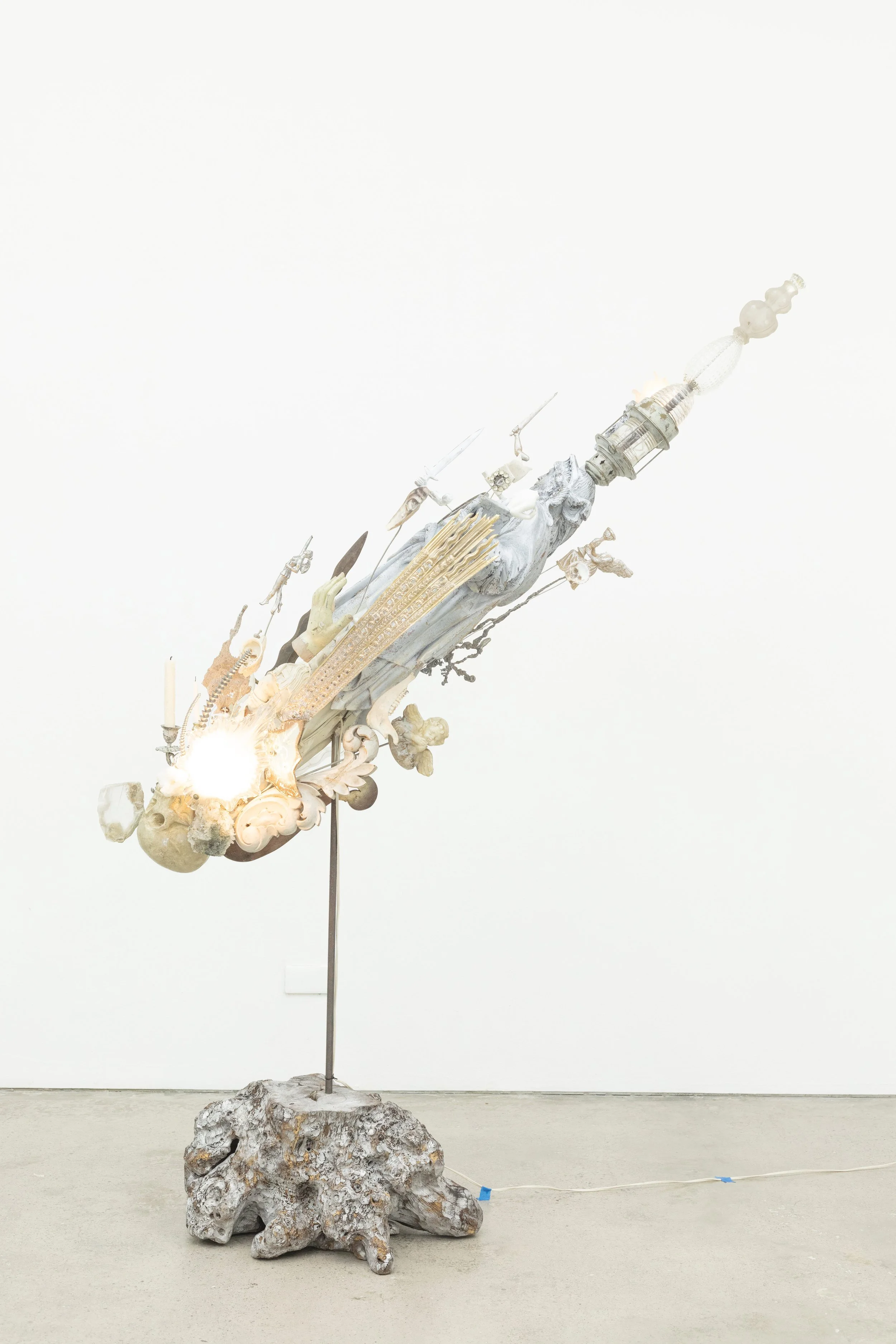
Triumph of Liberty Over Death (comet XVIII), 2025. Image courtesy of Silverlens.
That very tension between the universal and the hyperlocal can be traced through Halili’s titles. Triumph of Liberty Over Death (comet XVIII), 2025, for instance, nods to a clay sculpture titled The Triumph of Science over Death (1890) made by the celebrated Filipino writer and national hero José Rizal as a gift to his close friend Ferdinand Blumentritt, an Austrian writer, teacher, and sometimes translator of Rizal’s work. Rizal’s sculpture features an impossibly svelte nude woman standing over a skull, arms raised to hold a torch—a pose of desire that in turn accentuates her naked form.
This physical manifestation of an Enlightenment allegory—passed from one man to another and mediated by a nude female body—has since been widely adopted as an emblem by medical institutions in the Philippines, including in a monumental version at the University of the Philippines Manila campus. In that context, her body is made invisible under the symbolic weight. Halili extends this critique in Homage to Filipinas I (comet XV), 2024–25, and II (comet XXI), 2025. Both are arrowhead-shaped aggregations of female forms—bodhisattvas, nymphs, ballerinas, Aphrodites—that point to how often domestic objects recruit the nude woman as support, ornament, or punchline, and how thoroughly that objectification permeates everyday consumption.
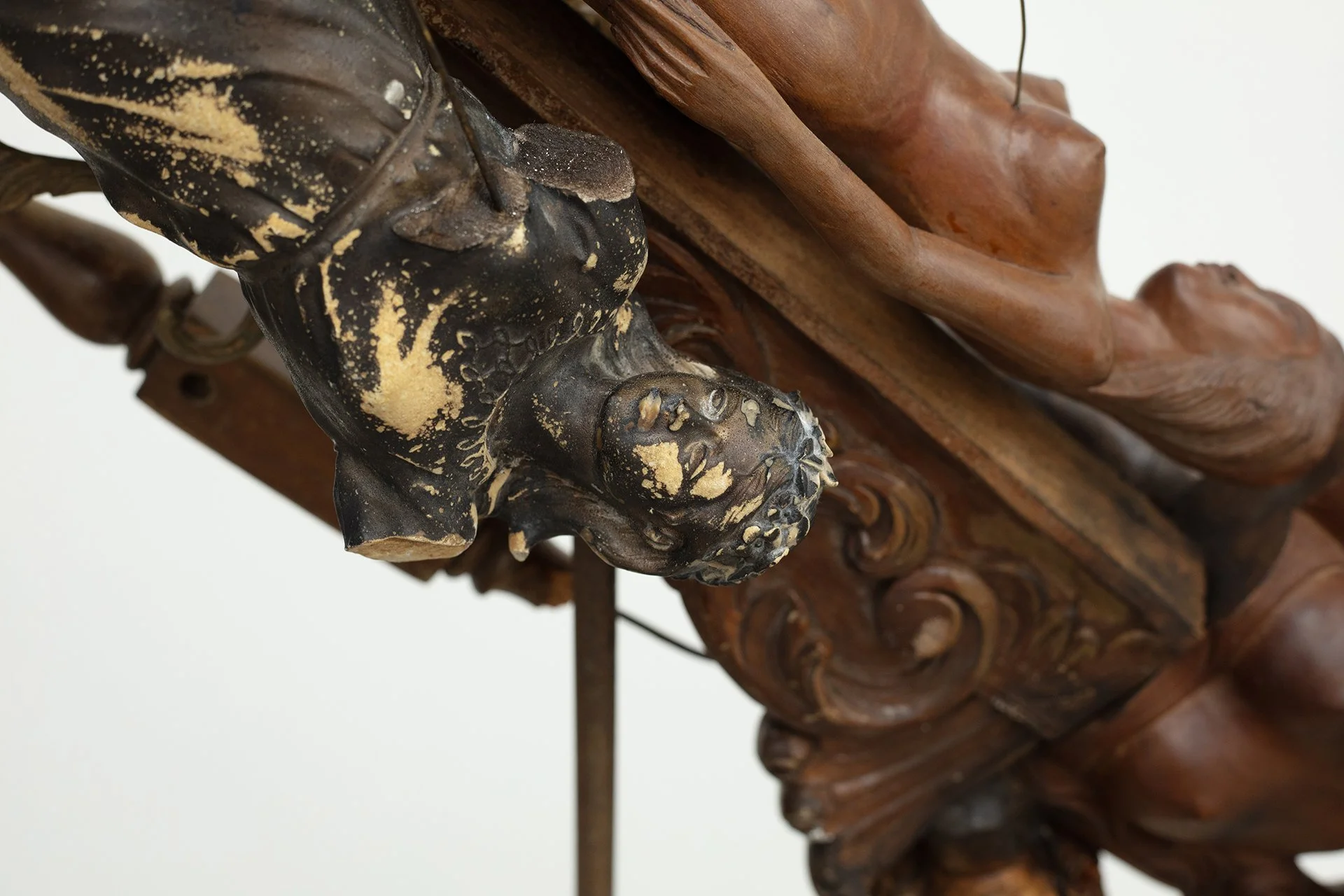
Detail of Crescent (comet XIV), 2024. Image courtesy of Silverlens.
In 2008, London’s Barbican staged Martian Museum of Terrestrial Art, an exercise in curatorial estrangement that asked: How would a Martian curate our art? Halili’s comets instead feel like a more pointed reversal: How would we bundle up our lived experience for the skies? The resulting comets show how consumerism has been made inseparable from extraction, and how political ideals have routinely been buttressed by compromised symbols. It’s a reminder that progress in this era of celestial expansion runs on cycles of terrestrial exploitation. While those cycles, like Halley’s comets, are inevitable, the only thing that can change is how these histories can be framed and visualized.