Paul Paiement’s Evergreen
Currently exhibited at Sabbatikal Gallery in Santa Monica, Paul Paiement’s Evergreen considers the relationship between architecture and the natural world; how we build within a landscape, alter it, and eventually begin to understand nature through the structures we place inside it.
Paiement’s shaped paintings initially appear as expansive landscapes: forests, wetlands, snow-covered fields, mountains, and open sky rendered with remarkable precision. Their contours, however, resemble contemporary homes, with pitched roofs, chimneys, and extending wings. Architectural outlines also cut through the scenery, creating structures that are present without ever becoming fully realized buildings.
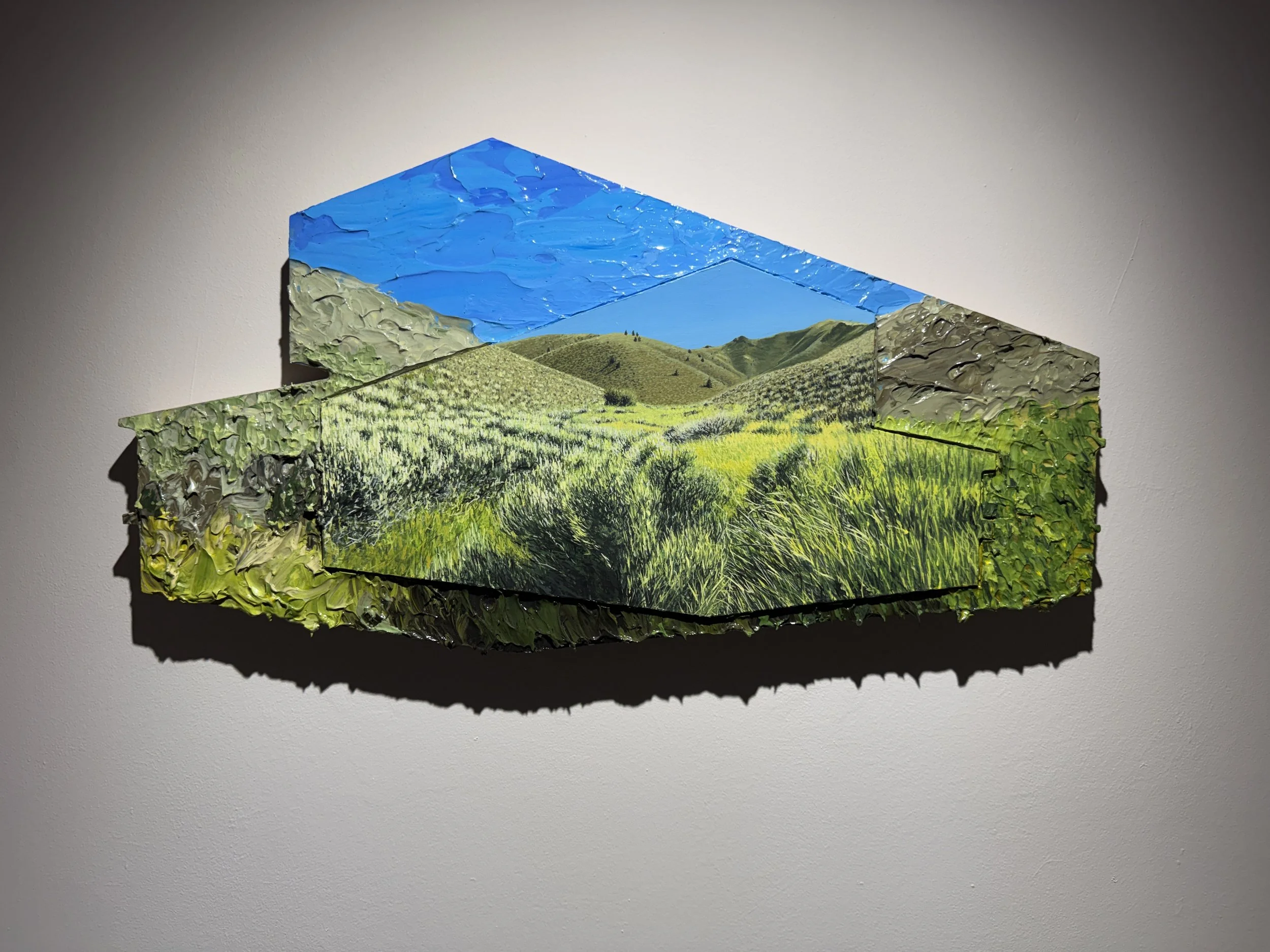
What interested me most was how these outlines function as frames. Within them, the landscape is often smooth and almost photographic. Outside, that illusion begins to break apart. Paint becomes thick and physical, accumulating into ridges that mimic grass, earth, clouds, and vegetation.
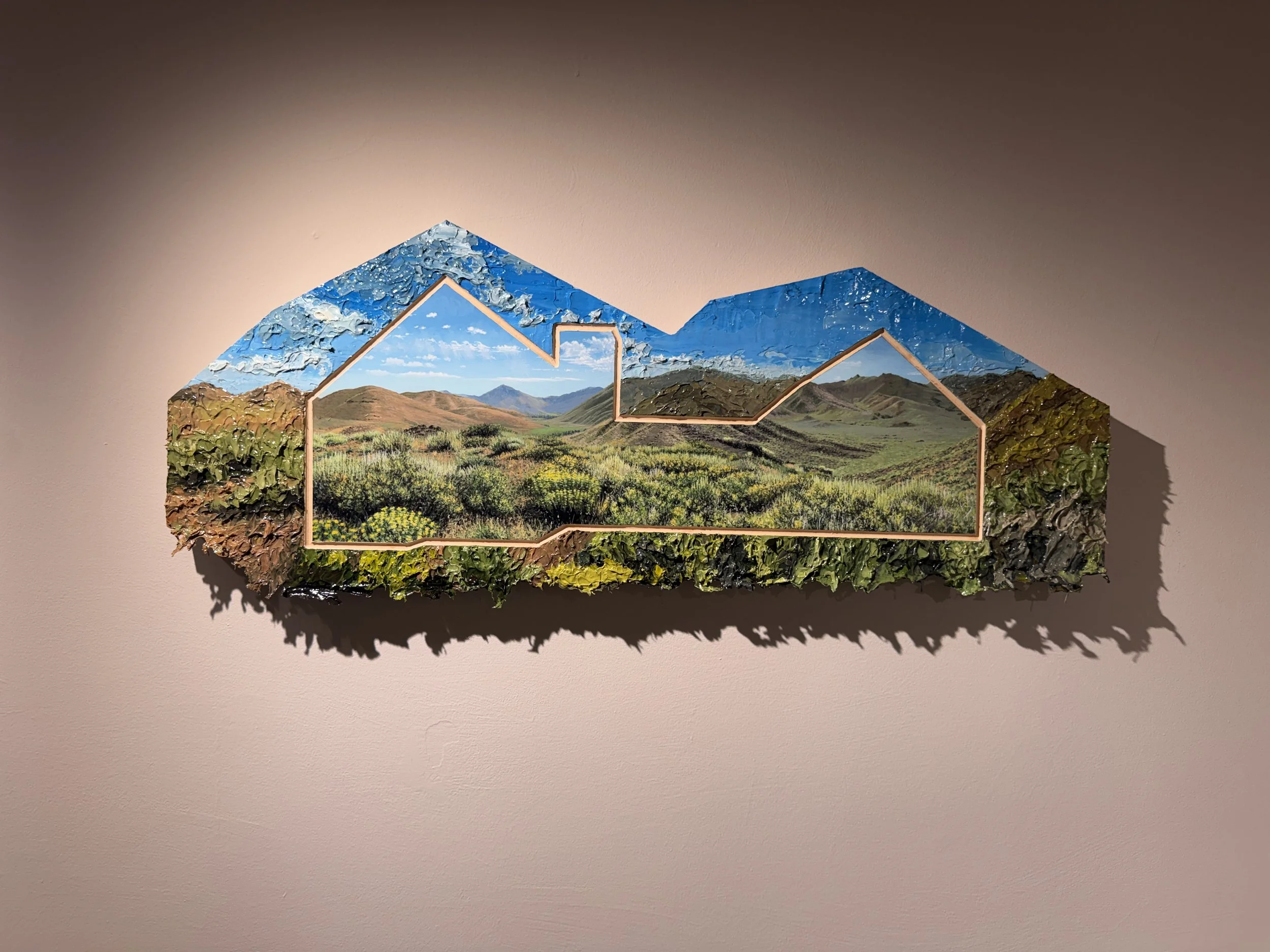
Nature shifts between image and material.
There is a contradiction here. The most convincing representation of nature is often contained within the boundaries of architecture. It made me think about how frequently we experience landscape this way. We build homes for their views, cut windows into walls, construct decks toward mountains, and landscape the land around us. Nature becomes something framed and organized through the architecture we introduce to it.
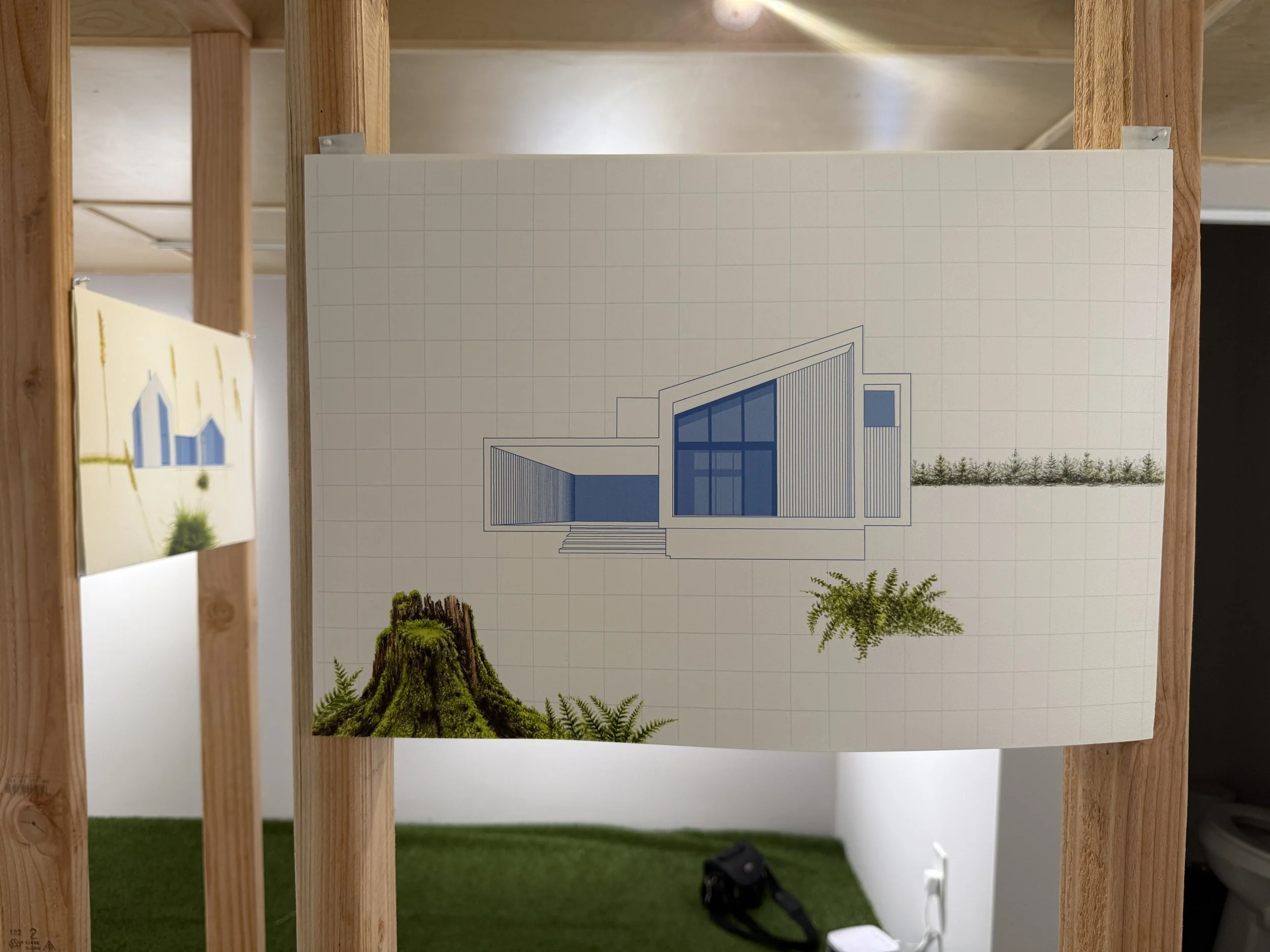
The works on paper approach this relationship differently. Thin blue lines describe buildings with the precision of architectural elevations, surrounded by large areas of open paper. Grasses, cattails, flowers, and other vegetation interrupt these controlled structures. The drawings seem suspended somewhere between proposal and memory; buildings either waiting to be constructed or slowly being reclaimed.
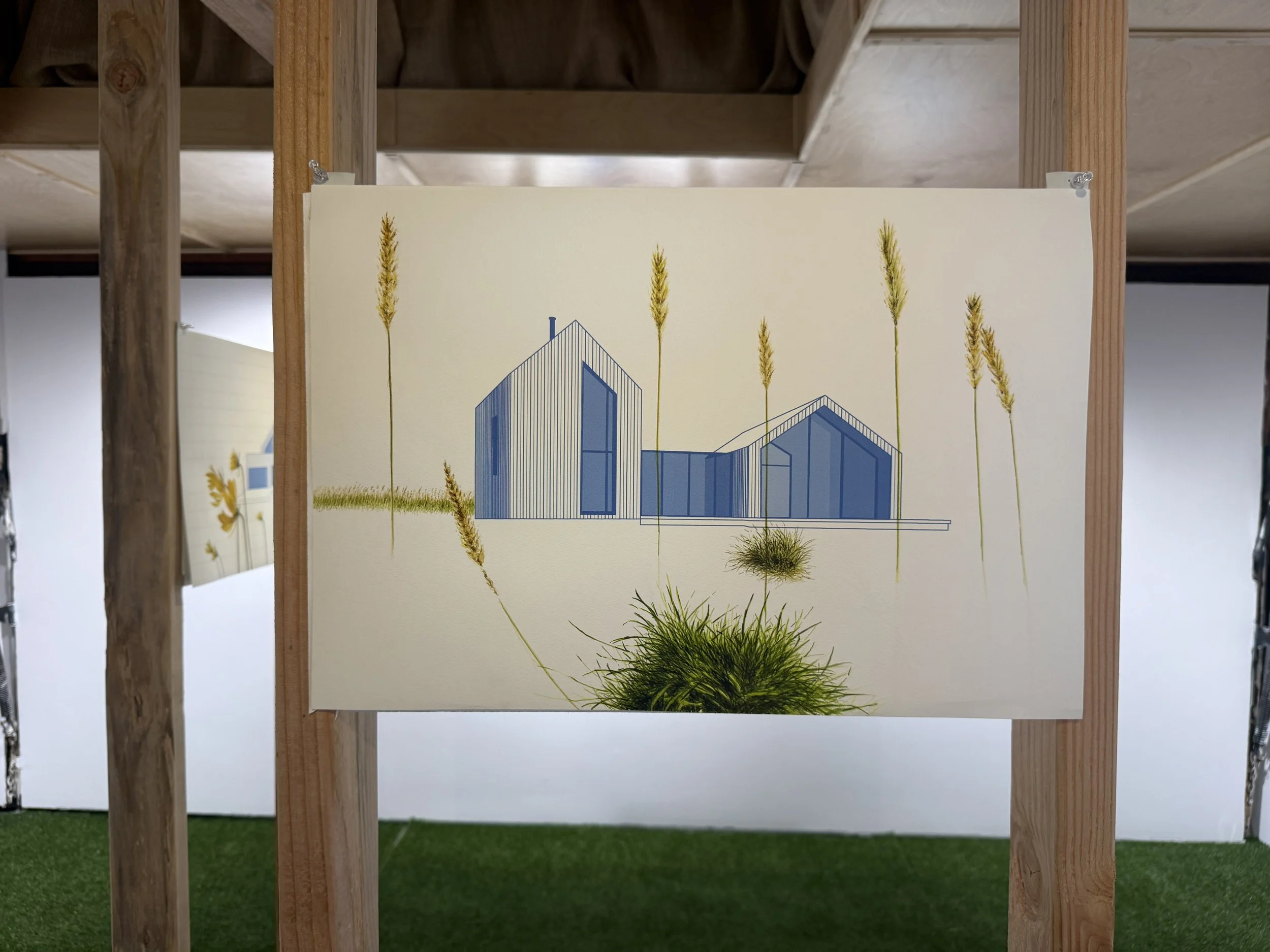
At the center of Evergreen, those architectural lines leave the page.
An exposed wooden framework occupies the gallery like the bare bones of a house. There are studs but no walls, revealing the infrastructure normally concealed once a building is finished. The works on paper hang directly from this framework, making it both an architectural intervention and a display system.
Its openness creates a more dynamic way of experiencing the exhibition. While looking at one drawing, I could see through the wooden studs to another work or to one of the shaped paintings along the gallery walls. As I moved, the beams divided and reframed these views, creating temporary compositions between works that might otherwise be experienced separately.
I found myself looking through the exhibition as much as looking at it.
The framework also mimics the linear architecture depicted in Paiement’s drawings, extending those lines from the page into physical space. Walking through it feels almost like entering one of the drawings before the building has been completed.
The materials complicate this relationship further. The framework is made from lumber: a natural material transformed and standardized for construction, while artificial turf covers the floor beneath it. Surrounded by representations of forests, fields, and vegetation, the synthetic grass becomes particularly striking. Nature is represented on the walls, transformed into construction material around us, and manufactured beneath our feet.
This is where the title Evergreen begins to feel less straightforward.
An evergreen suggests something persistent, capable of remaining through changing seasons. Yet throughout the exhibition, materials and environments are continually being transformed. Trees become lumber. Landscape becomes property. Grass becomes a manufactured surface. Nature becomes an image, while architecture becomes the frame through which that image is seen.
Paiement does not position architecture simply as an intrusion into an otherwise pristine environment. Instead, Evergreen considers how deeply the built and natural worlds have already become entangled. We build within landscapes because we want proximity to them, even as that construction inevitably alters what drew us there in the first place.
Through the outline of a house, we see a valley. Through exposed wooden studs, we see another painting. Across an architectural drawing, vegetation begins to grow.
There is always something framing the landscape.
Paul Paiement: Evergreen is exhibited at Sabbatikal Gallery in Santa Monica and is currently available to view by appointment.